
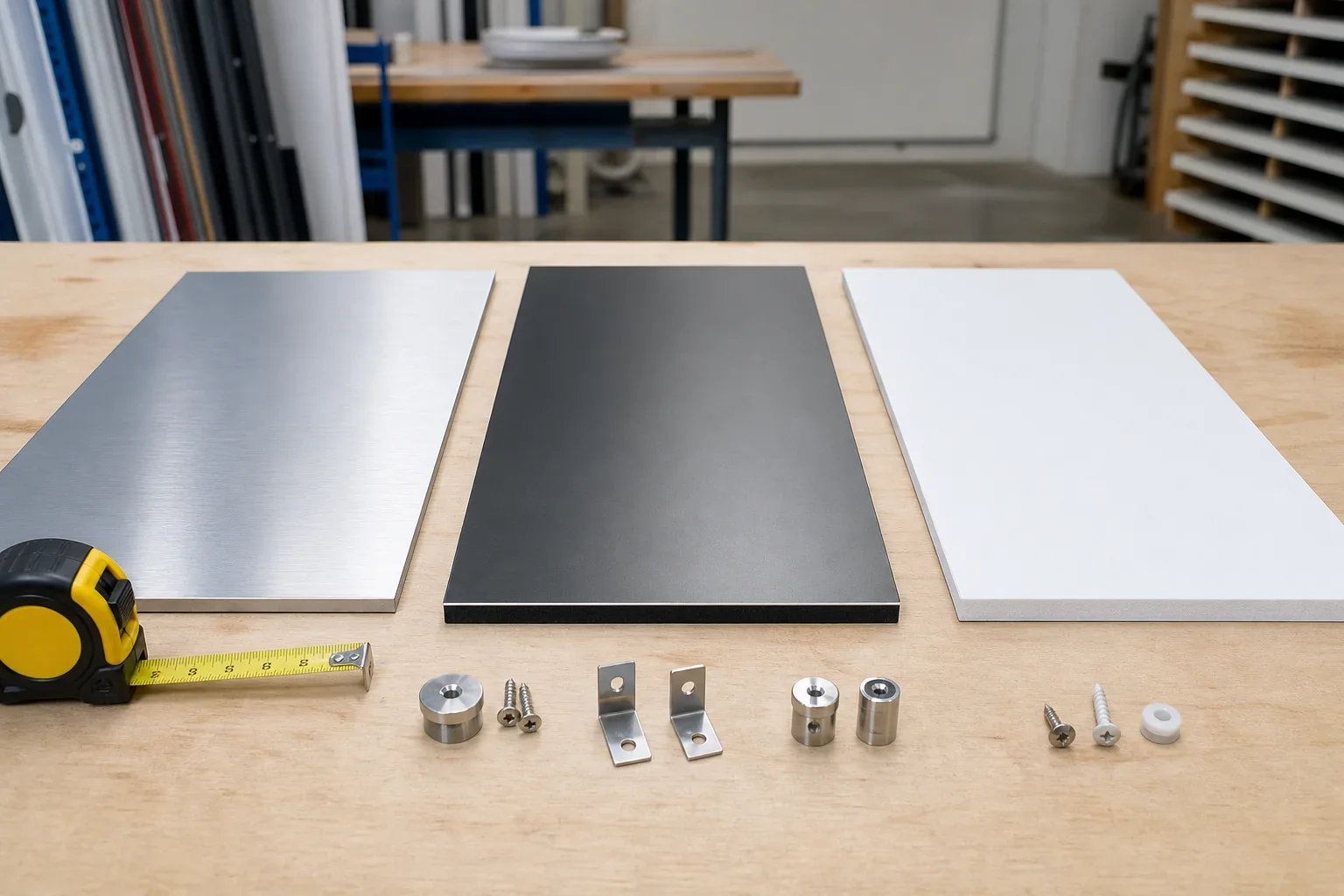
Quick takeaways
Side-by-side comparison
| Feature | Solid aluminum | ACM or expanded PVC |
|---|---|---|
| Panel construction | A single aluminum sheet with consistent metal strength throughout the panel. | ACM has aluminum skins around a core; expanded PVC is a solid foam-like plastic sheet. |
| Rigidity | The strongest option of the three for a comparable flat panel, especially when the sign may face impact or wind. | ACM is stiff for its weight. PVC is rigid but can flex, dent, or deform more readily depending on size and support. |
| Weight | Light for a metal sign, but generally heavier than a comparable ACM or PVC panel. | ACM is typically lighter than solid aluminum, and PVC is also easy to handle for many indoor panels. |
| Outdoor suitability | Well suited to exposed exterior signs when the graphics, edges, fasteners, and mounting are selected for the site. | ACM can work well outdoors. PVC is usually better for indoor or sheltered use because heat, sun, and moisture can affect it. |
| Finish and graphics | Can receive printed graphics, applied vinyl, or a painted or finished surface depending on the design. | Both can receive printed graphics or vinyl. ACM provides a smooth, commercial-looking face; PVC is commonly used with a clean white face. |
| Mounting | Can be screwed, bolted, or mounted with standoffs, frames, rails, or other hardware suited to the surface. | Both can be fastened directly or mounted with standoffs. Larger panels may need more attachment points or support. |
| Dimensional work | Can be cut, folded, or fabricated into formed metal components, but it is not the easiest material for every routed detail. | ACM and PVC are often convenient for cut shapes, layered panels, and routed details, with PVC commonly used for lightweight dimensional pieces. |
| Typical business uses | Exterior wall signs, property or facility signs, durable identification panels, and signs exposed to frequent handling. | ACM: storefront panels, construction or site signs, directories, and branded wall panels. PVC: indoor directional signs, menu boards, event signs, and displays. |
Start with the sign’s location and mounting surface
A flat wall-mounted panel has different needs from a sign hanging between posts or attached to a vehicle. Measure the available area and note whether the surface is masonry, metal, wood, glass, or a vehicle panel. The mounting surface affects the hardware, hole placement, and amount of support needed.
For a storefront wall in Tampa Bay, consider direct sun, heavy rain, humidity, and wind exposure. Those conditions do not automatically rule out ACM or PVC, but they make edge treatment, graphic selection, fasteners, and secure installation more important. A protected interior lobby sign has far fewer environmental demands.
- Large panels need enough attachment points to resist flexing and movement.
- Recessed areas, uneven walls, and trim can require spacers, rails, or a shaped panel.
- Confirm any property, vehicle, or local requirements for the specific installation before production.
When solid aluminum makes sense
Solid aluminum is the straightforward choice when a sign needs a durable metal panel and extra resistance to bending or handling. It works well for exterior identification, equipment or facility signs, and panels that may be removed and reinstalled. It can also be fabricated into folded or formed pieces when a flat sheet is not enough.
Its tradeoff is weight and fabrication. A larger aluminum panel may need more careful handling and stronger mounting than a smaller one. The finished appearance also depends on whether the design uses direct print, applied vinyl, paint, or another surface treatment.
- Use it when panel strength matters more than the lightest possible installation.
- Consider it for exposed locations, high-touch areas, or signs that need a metal appearance.
- Plan holes, bends, corners, and mounting hardware before the panel is produced.
Why ACM is a common flat-panel choice
Aluminum composite material, or ACM, uses thin aluminum faces bonded to a lightweight core. That construction gives it a smooth, flat face without the weight of a solid aluminum sheet. It is a practical fit for many wall panels, tenant signs, directories, and site signs where a clean appearance and easy handling are useful.
ACM is not the same as solid aluminum. Its edges and core need to be considered during cutting and mounting, and a large panel may still require adequate support. For an exterior application, ask how the panel will be finished and attached rather than choosing it only by its face color.
- Choose ACM when a broad, flat panel should be light enough for efficient handling.
- It works well with printed graphics and applied vinyl for many commercial sign layouts.
- Use a mounting plan that keeps the panel supported and limits movement in exposed areas.
Where expanded PVC fits best
Expanded PVC is a lightweight plastic sheet often used for indoor graphics, directional signs, menu boards, event panels, and protected displays. It is easy to cut into shapes and can be useful for layered or dimensional sign elements when the application does not demand a heavy-duty exterior panel.
PVC can be the wrong choice for a large, permanently exposed sign. Heat, direct sun, moisture, panel size, color, and mounting all affect how it performs. In Florida, an unprotected PVC panel may experience more movement or surface change than it would in a climate-controlled interior. If the sign will live outside, ask whether ACM or solid aluminum is a better fit.
- Choose PVC for indoor or sheltered locations where low weight and easy cutting are helpful.
- Use it for temporary event signage when the panel does not need the structure of a permanent exterior sign.
- Avoid treating PVC as a direct substitute for metal on every outdoor project.
Match the material to the finished sign
The material is only one part of the result. A sign with small lettering, a full-color image, routed corners, standoffs, or a folded return may need a different production approach than a simple rectangular panel. The graphic method also affects the appearance: applied vinyl can be replaced or removed differently from a printed face, and dark colors can behave differently in direct sun than light colors.
For a vehicle, the panel choice may not apply at all. Recessed van panels, curved bodywork, and doors usually call for vehicle lettering or wrap film rather than a rigid board. For windows, use a window graphic system designed for glass. Keep the rigid panel decision focused on walls, posts, displays, and other solid mounting surfaces.
- Send the intended size, viewing distance, artwork, and installation location with the quote request.
- Include photos that show the wall, nearby trim, access, and any existing holes or hardware.
- Ask about edge finishing, print or vinyl options, and the support needed for the finished dimensions.
Frequently asked questions
Is ACM stronger than PVC for an outdoor sign?
ACM is generally the better outdoor panel of the two because its aluminum faces provide more stiffness and a more stable finished surface. The correct choice still depends on panel size, exposure, graphics, edges, and mounting. Solid aluminum may be preferable when the sign needs additional metal strength or impact resistance.
Can a rigid sign be mounted with standoffs?
Yes, aluminum, ACM, and PVC panels can often be mounted with standoffs when the panel thickness, size, hole locations, and wall structure are suitable. The installer should select hardware and support based on the finished sign and the mounting surface, not just the material name.