
Quick takeaways
Side-by-side comparison
| Feature | Cast vinyl | Calendered vinyl |
|---|---|---|
| Conformability | Highly flexible and able to follow compound curves, recesses, body lines, and other irregular shapes when properly installed. | Best on flat surfaces and simple curves; it may resist deep contours or require relief cuts and careful application. |
| Shrinkage tendency | Generally lower shrinkage because the film has less manufacturing memory, though installation and exposure still matter. | Generally more prone to shrinkage over time, especially when stretched around curves or exposed to strong heat. |
| Common applications | Full or partial vehicle wraps, fleet graphics, complex vehicle lettering, contoured equipment, and demanding outdoor graphics. | Flat sign faces, windows, wall graphics, basic vehicle lettering, temporary promotions, decals, and many labels. |
| Project considerations | A strong choice when appearance across curves, reduced distortion, and long-term outdoor performance are important. | A practical choice when the surface is simple and the project prioritizes value, straightforward installation, or planned replacement. |
A flat sign is a different job from a recessed van panel
Look at where the graphic will sit before deciding which vinyl to buy. A smooth storefront window or rigid sign panel gives the film a fairly simple surface. A van may have a deep channel along the side, curved corners, handles, and separate body panels. Covering those shapes puts more demands on the material and the installer.
That distinction matters even when two quotes describe the job as vehicle graphics. A small decal on a flat door and a full wrap around a bumper are different applications. Ask which film is being quoted and whether it is intended for the hardest part of your particular surface.
Photos are useful here. A close-up of the recess or curve tells the shop more than a description such as “the side of the van.” Include a wider photo too, so the proposed size and placement are clear.
Where cast film earns its place
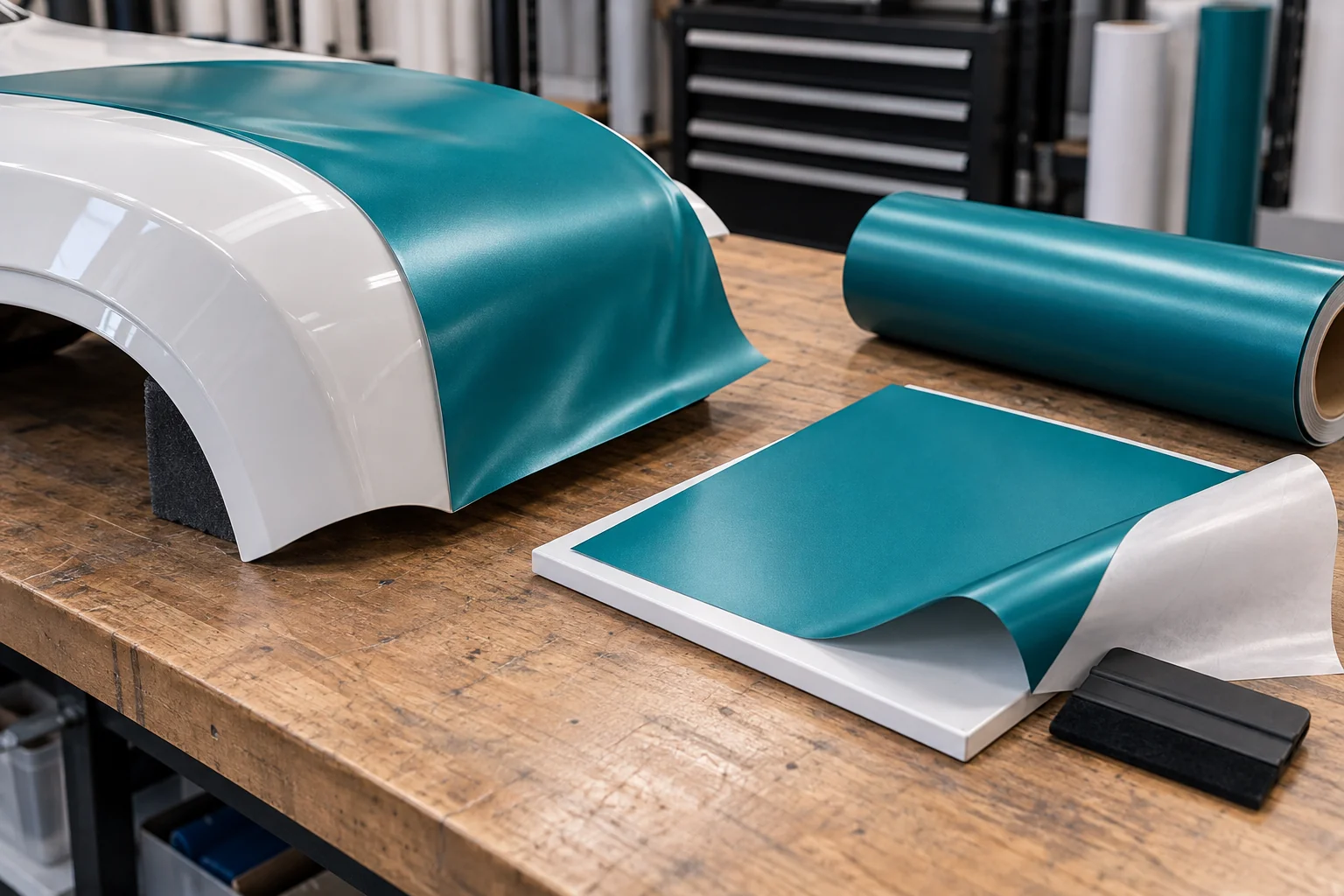
Cast vinyl is made by spreading a liquid formulation onto a casting surface and forming it into a film. It is generally thin, flexible, and more dimensionally stable than calendered vinyl. In practical terms, it follows difficult shapes more readily and tends to shrink less.
Those properties make cast film a common choice for full wraps, recessed vehicle panels, rivets, and compound curves. A compound curve bends in more than one direction; the corners of a bumper are a useful example.
Cast film still has application limits. It cannot make failing paint sound, turn an unsuitable plastic surface into a good bonding surface, or compensate for poor installation. The manufacturer’s guidance for the specific film matters more than the word “cast” on its own.
Where calendered film makes sense
Calendered vinyl is formed through rollers. It is often thicker and more economical than cast film, making it a practical option for many flat signs, window graphics, labels, and promotional decals.
There are different grades of calendered film, so it helps to know the actual product being proposed. A short-term promotional film and a higher-performance sign film should not be treated as interchangeable just because both are calendered.
A straightforward door decal may suit a calendered product approved for that use. Taking the same film into a deep recess can be a different story. Stretching a film beyond its intended application can lead to edges pulling back or areas lifting later.
Why edges, laminate, and installation matter
Shrinkage is easiest to notice at an edge or seam. A graphic can look good when it leaves the shop, then pull back if the film was stretched beyond its limits or the application was unsuitable. Cast film generally has an advantage here, but it still needs the right installation.
For printed graphics, ask about the film and laminate together. The laminate is the protective layer over the print. It should suit the film and the application; adding laminate does not turn a flat-surface film into a suitable wrap film.
Florida sun and hot vehicle panels add to the demands on a graphic. Exposure, parking, cleaning, paint condition, and the chosen product all affect how it holds up. A material name alone is not enough to promise a certain number of years.
Removal deserves a place in the conversation too. Tell the shop if a promotion will be changed soon or a vehicle will need to return to its original appearance. The adhesive, surface condition, and time spent installed can affect that work.
What to send when you ask for a quote
Send the finished size, artwork or design idea, and photos of the surface. For a vehicle, include the year, make, and model, along with any areas the graphics need to cover. Mention old graphics, damaged paint, or textured trim.
Also say whether you want a temporary promotion, simple business lettering, a partial wrap, or a full wrap. If two quotes use different materials, ask each shop to identify the film, laminate, coverage, and installation included.
Send those details to Tampa Signs and Stickers, and we can recommend a material for the actual job.
Frequently asked questions
Can calendered vinyl be used on a vehicle?
Yes, when the specific film is approved for the surface and application. Simple lettering on a flat panel can be suitable. Deep recesses and compound curves usually call for a more conformable film.
Will choosing cast vinyl guarantee a longer life?
No. Cast film generally offers lower shrinkage and better conformability, but the exact product, installation, exposure, and surface condition all affect performance.