
Quick takeaways
Side-by-side comparison
| Feature | Higher coverage options | Lower coverage options |
|---|---|---|
| Typical coverage | A full wrap covers most visible painted panels. A partial wrap may cover one side, the rear, lower panels, or another planned portion. | Door graphics and spot graphics cover selected areas. Cut-vinyl lettering usually uses individual letters, numbers, or simple shapes. |
| Visual impact | Full wraps support large images, color fields, patterns, and designs that continue around the vehicle. Partial wraps can still create a strong focal area. | Lettering is direct and easy to read. Door and spot graphics add emphasis without making the entire vehicle a designed surface. |
| Budget factors | More printed film, panel preparation, design time, wrapping labor, and complex curves generally increase the quote. | Less coverage often reduces material and labor, but difficult surfaces, multiple colors, installation access, and custom design still affect the price. |
| Fleet consistency | A documented full or partial layout can create a recognizable system across different vehicle sizes, with adjustments for doors, windows, handles, and body lines. | Lettering and spot graphics are easier to repeat across mixed vehicles when the fleet needs a simple, consistent identification package. |
| Removal and changes | Removal can take more labor because there is more material and more panel area. A full wrap may need planning if only part of the information changes. | Smaller graphics are usually more limited in scope to remove or replace, especially when a phone number, employee name, or service changes. |
| Common commercial uses | Service vans, delivery vehicles, contractors, mobile businesses, trailers, and vehicles that need a large visual presence often use full or partial wraps. | Local service vehicles, sales vehicles, property-management fleets, temporary campaigns, and vehicles needing basic identification often use lettering or spot graphics. |
What a full wrap changes about the vehicle
A full wrap turns most of the vehicle into one continuous printed surface. It can use photography, illustrations, color blocks, or a patterned design across the sides, rear, hood, and other practical panels. The layout must account for door seams, handles, mirrors, wheel arches, fuel doors, body contours, and areas that cannot accept film.
This option makes sense when the vehicle travels throughout Tampa Bay and you want the design to be visible from several angles. It also gives a designer more room to separate a company name, service description, phone number, and call to action. A full wrap is not automatically the best choice, though. If the vehicle is replaced soon or the message changes often, the larger installation and removal scope may not fit the plan.
Florida exposure is another planning factor. Sun, heat, rain, humidity, washing methods, storage, surface condition, and the selected film and print system all affect how graphics perform outdoors. A wrap should be specified for the vehicle and use rather than treated as a permanent coating.
- Best for a large, image-led design and broad panel coverage.
- Requires careful panel measurements and a design proof that shows seams and body features.
- Plan removal when the vehicle is leased, reassigned, sold, or likely to receive a new message.
Where partial wraps, door graphics, and spot graphics fit
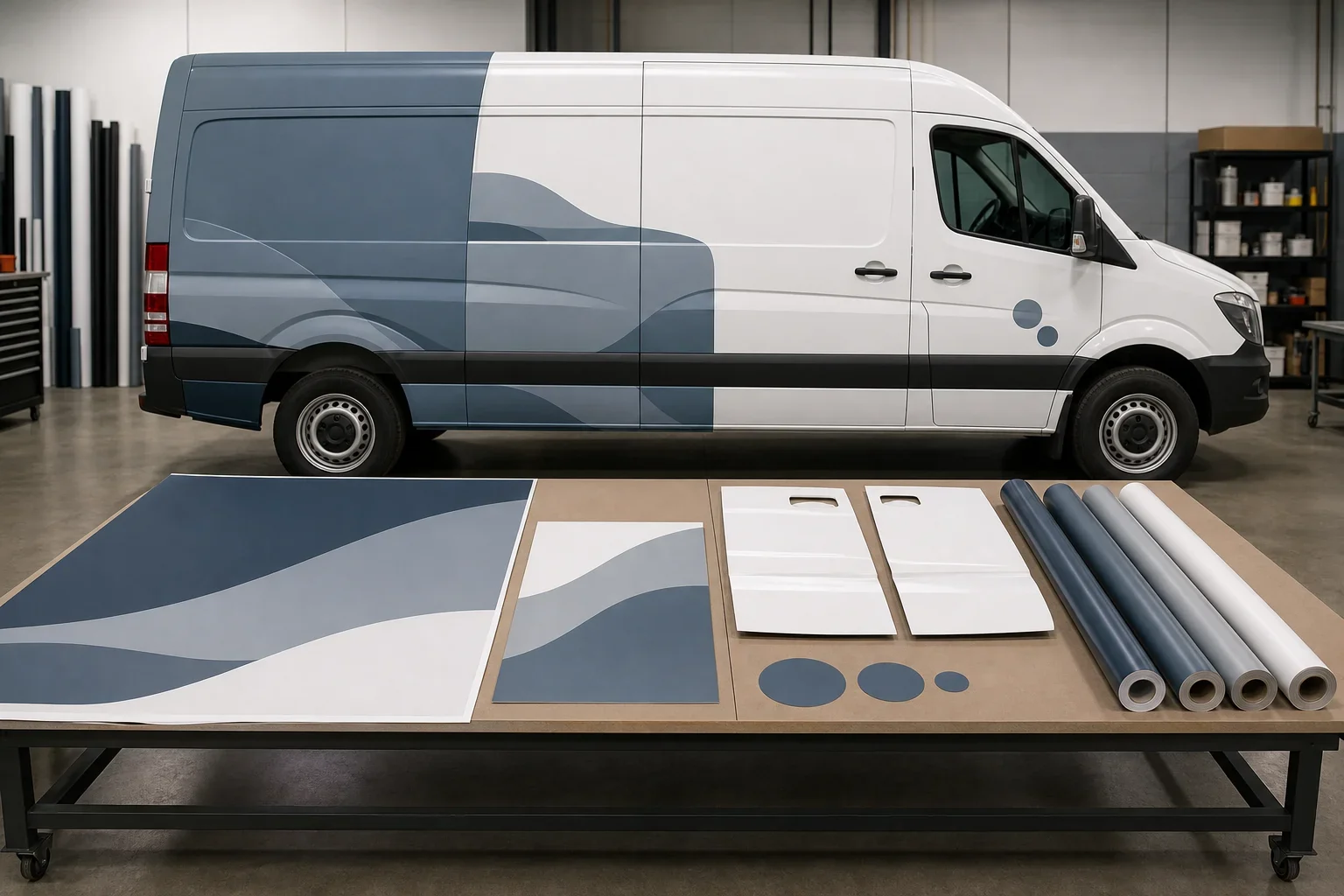
A partial wrap uses larger printed sections but leaves some painted panels visible. For example, a design might cover the rear quarter panels and lower sides while keeping the upper body white. The visible paint becomes part of the design, so its color and condition need to be considered from the beginning.
Door graphics are a focused version of this approach. They may place a logo, service name, phone number, or a small printed panel on the front doors. They work well when the main goal is clear identification at a jobsite or in traffic, without designing every side of the vehicle.
Spot graphics are smaller printed elements placed where they support the layout: a logo near a rear hatch, an icon on a side panel, or a few service images on a van. They can add color and recognition to a lettering package. These choices are useful when a business wants more personality than plain text but needs to control coverage or leave room for changing information.
- Use the vehicle's existing paint as a deliberate background, not an accidental gap.
- Measure both sides separately when body shapes, sliding doors, or equipment create differences.
- Keep key information away from handles, hinges, deep recesses, and areas that are difficult to clean.
When cut-vinyl lettering is the practical choice
Cut-vinyl lettering is produced by cutting individual letters, numbers, or simple shapes from colored adhesive vinyl. Unlike a printed wrap, it does not create a photographic or full-color image. That makes it a straightforward choice for a business name, phone number, website address, license or unit identification, or a short list of services.
Lettering is often easier to standardize across a mixed fleet. A compact van, pickup, box truck, and trailer may not share the same panel dimensions, but the same type treatment and information hierarchy can be adapted to each one. It can also be easier to update one section when a phone number or employee information changes.
The tradeoff is visual coverage. Small lettering can disappear into a busy vehicle or be difficult to read at a distance. A simple design with adequate contrast, sensible letter sizes, and enough clear space usually communicates better than trying to fit every service onto one door.
- Best for information that must be read quickly and repeated across vehicles.
- Works well alone or with a small printed logo or spot graphic.
- Prepare final wording carefully; changing individual letters is simpler than replacing a large printed panel, but the existing adhesive area still needs to be assessed.
How to choose for a fleet or one vehicle
Start with the job the vehicle needs to do. A plumbing van that must be recognized at a residential driveway may need a readable name, phone number, and service category more than a full photographic design. A food, event, delivery, or mobile-service business may benefit from larger graphics that show what the vehicle offers before someone reads the details.
For a fleet, create a basic graphic system before producing the first vehicle. Decide which information stays fixed, which fields change, how much space the name receives, and how the layout adapts to short vans, pickups, trailers, and box trucks. Door placement and recessed panels can make a design look different from one body style to another, even when the artwork is technically the same.
Ask for a quote using clear vehicle information: year, make, model, body style, photos of each side, approximate measurements, existing graphics, and the areas you want covered. Include whether the vehicle has dents, textured surfaces, old adhesive, paint repairs, roof equipment, ladder racks, or door hardware. Those details affect preparation, design, installation, and removal.
- Choose coverage based on viewing distance and the vehicle's daily routes, not only on the amount of artwork available.
- Separate permanent business information from details that may change between vehicles.
- Request a proof over vehicle templates before approving production.
Frequently asked questions
Can a partial wrap and cut-vinyl lettering be used together?
Yes. A printed panel can carry color, imagery, or a service theme, while cut-vinyl lettering supplies the business name, phone number, unit number, or other information. Combining them can create hierarchy without covering every panel.
Should the same design be used on every vehicle in a fleet?
Use the same core system rather than forcing identical artwork onto every body style. Keep the logo treatment, colors, typography, and information order consistent, then adjust panel placement for doors, windows, recesses, wheel arches, and available space.
What should be removed before installing new vehicle graphics?
Tell the sign shop about existing wraps, lettering, stickers, adhesive residue, paint damage, and repairs. Old adhesive or unstable paint may require removal or additional surface preparation before new vinyl can be installed properly.