
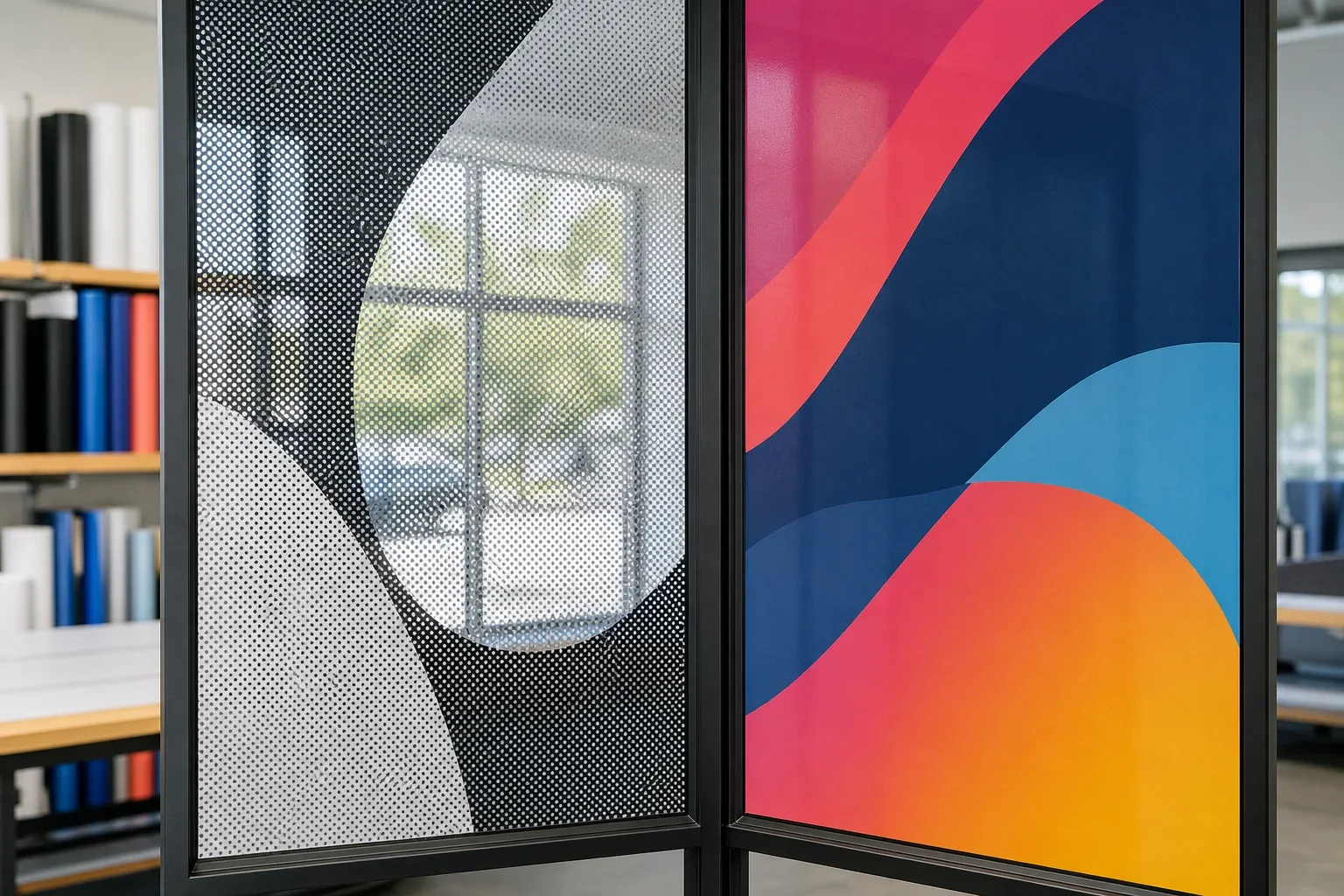
Quick takeaways
Side-by-side comparison
| Feature | Perforated window film | Solid vinyl window graphics |
|---|---|---|
| Visibility from inside | Allows some outward visibility through the printed pattern, depending on the film, lighting, cleanliness, and viewing distance. | Blocks the covered area unless the design leaves openings or uses cut lettering and shapes. |
| Privacy | Provides partial daytime screening, but privacy can reverse at night when the interior is brighter than outside. | Provides stronger privacy across the covered area, with no see-through view through the vinyl itself. |
| Print impact | The graphic is printed on film with a pattern of small holes. Fine details and small type can appear less sharp or less dense. | Produces a more solid, saturated appearance with cleaner fine detail and stronger image contrast. |
| Interior light | Preserves more natural light than a fully covered solid panel, although the printed pattern still reduces light. | Can noticeably reduce light on covered panes, particularly with dark, opaque, or fully printed designs. |
| Best storefront role | Useful for broad window campaigns, privacy screening, promotional images, and graphics that need to leave some view through the glass. | Useful for bold branding, hours and service information, privacy panels, opaque backgrounds, and high-impact display graphics. |
| Common vehicle use | Often used across rear or side window areas where outward visibility is needed, subject to the vehicle and local requirements. | Better for body panels or window areas where visibility is not needed; vehicle glass applications should be reviewed for the specific use. |
Start with what the pane needs to do
A flat storefront window may need to carry a large promotional image while still letting staff see the sidewalk. Perforated film can be a practical fit because the graphic is visible from the brighter viewing side and the open areas allow some view from the other side.
A reception window, conference-room pane, or service counter may have a different goal. If the glass should hide storage, equipment, work areas, or customer activity, solid vinyl gives you a more dependable visual barrier. It can cover the entire pane or be combined with cut lettering and clear glass openings.
Visibility and privacy depend on lighting
Perforated film is often described as one-way vision, but that description has limits. The effect relies on a difference in brightness between the graphic side and the viewing side. During daylight, a person inside may see through toward the street while people outside mainly see the printed image. At night, bright interior lights can make the inside more visible and reduce the privacy effect.
The perforations do not leave a completely clear view. The pattern, viewing distance, lighting, and condition of the film affect what you can see. If your business operates after dark, assess the nighttime view before using perforated film for privacy.
Print quality, color, and interior light
Solid vinyl gives artwork a continuous surface. Photos, gradients, small text, strong brand colors, and fine outlines generally appear cleaner because the viewer is not looking through a pattern of holes. It is usually the better choice when the graphic needs to function like a large wall mural on glass.
Perforated film trades some print density for visibility. Large shapes, simple messages, and high-contrast images tend to work better than tiny text or intricate details. A design that looks bold on a monitor may appear softer once it is printed on a perforated pattern.
Both materials change the amount of light entering the space. Perforated film usually leaves more daylight than a fully covered solid panel, while a dark solid graphic can make a waiting area or sales floor feel noticeably dimmer. A sample viewed on the actual pane is more useful than judging the design on a screen.
Plan the window one pane at a time
Measure each pane separately. Mullions, door hardware, and any areas that need to stay clear affect the layout. If an image runs across several panes, plan those breaks before artwork is approved.
Keep important text away from edges and moving hardware. For a glass door, consider whether the graphic will be seen while someone is approaching, opening, or standing behind it. Depending on the design, cut vinyl lettering, a solid lower panel, or a smaller graphic may work better than covering the whole door.
If old film or adhesive is present, include removal and glass preparation in the quote. Any seams should be planned with the artwork rather than left as a surprise during installation.
Common commercial uses
Perforated film is commonly considered for storefront promotions, restaurant windows, clinic or office screening, temporary event graphics, and vehicle window areas where a graphic and outward view are both useful. It works best when the message can be read at the distance people will actually stand and when some interior visibility is valuable.
Solid vinyl is commonly used for opaque privacy bands, full-window graphics, office meeting-room panels, branded backgrounds, hours and service lettering, and display areas that need strong color. It also works well when the interior view is distracting or when the glass should visually recede behind a clean design.
What to send for a useful quote
Send photos taken straight on and from inside the space, along with the width and height of each pane. Note which windows are doors, whether the business needs daytime or nighttime privacy, the hours the space is occupied, and whether staff must see through the glass.
Include the artwork if it is ready, or describe the message, colors, image size, and any panes that must remain clear. Tampa Signs and Stickers can then help compare a perforated layout, a solid vinyl layout, or a combination of both.
Frequently asked questions
Can people see through perforated window film at night?
They may be able to, especially when the interior is brighter than the exterior. Perforated film should not be treated as guaranteed nighttime privacy; test the lighting conditions or use solid vinyl where privacy is critical.
Can perforated and solid vinyl be used together?
Yes. For example, a storefront may use perforated film on a broad display pane, solid vinyl on a privacy section, and cut lettering on the door. Separating the functions by pane can preserve sightlines while keeping key information readable.