
Quick takeaways
Side-by-side comparison
| Feature | Full wrap | Partial wrap |
|---|---|---|
| Coverage | Covers most or all visible exterior panels included in the scope. | Covers selected areas, such as doors, rear panels, or a side-panel graphic. |
| Material use | Uses more printed or colored vinyl and laminate. | Uses less material, although complex panel shapes can still affect production. |
| Design approach | The artwork must account for the entire vehicle, including seams, curves, handles, and panel breaks. | The design can focus on specific high-visibility areas and coordinate with the vehicle’s existing color. |
| Installation labor | Usually involves more panel preparation, alignment, trimming, and finishing. | Usually involves fewer panels, but difficult recesses or edges can still require careful installation. |
| Best fit | A vehicle that needs a broad visual change or graphics across most of its exterior. | A business that wants identification or advertising on selected areas without covering the whole vehicle. |
| Quote details to confirm | Ask which panels, mirrors, bumpers, roof areas, and removable parts are included. | Ask for a panel-by-panel scope so “partial” has a clear meaning. |
The vehicle’s size and shape set the starting point
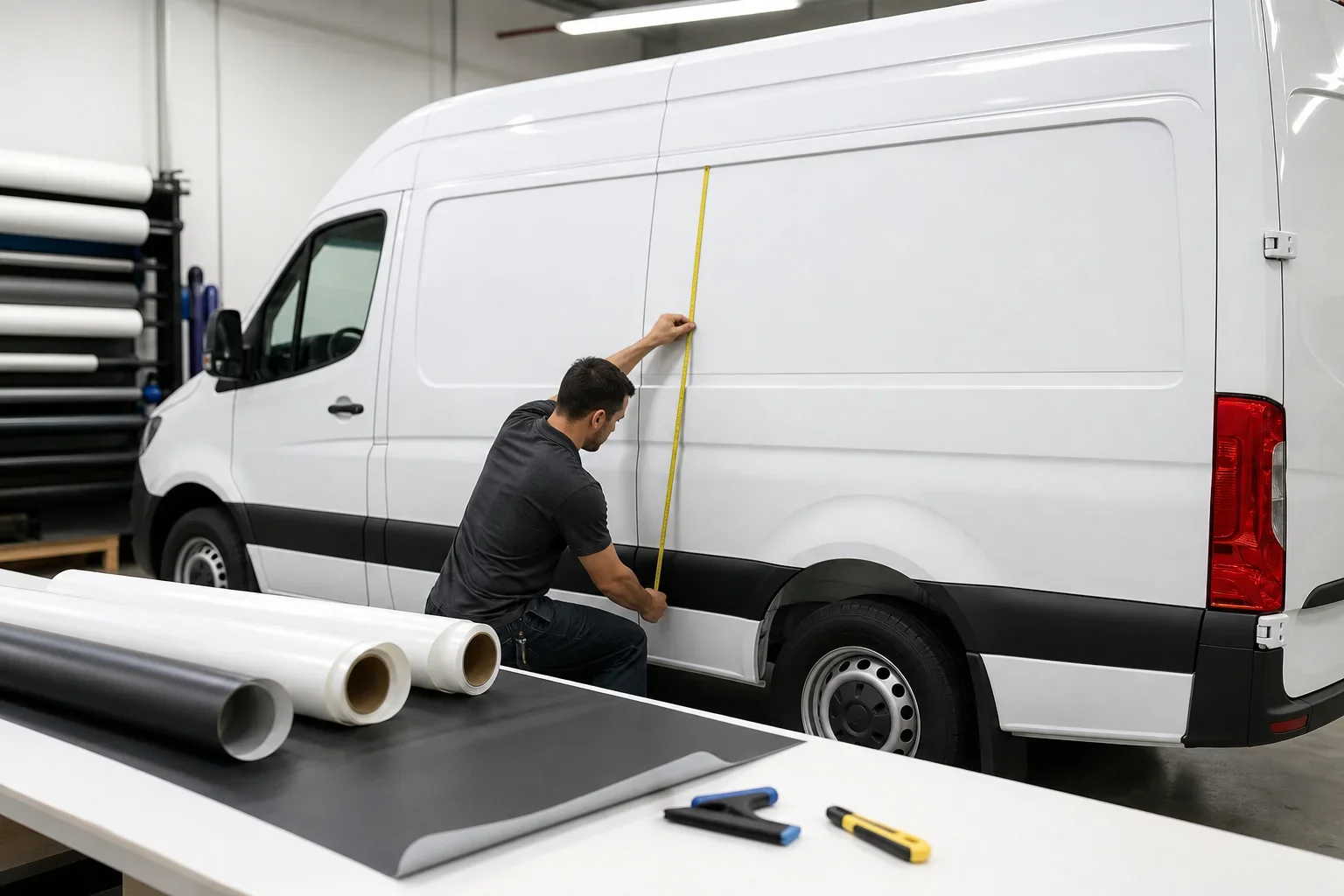
A compact car, pickup, high-roof van, and box truck do not require the same amount of vinyl or installation time. Larger vehicles need more material, but shape can matter just as much as square footage. A flat box truck side is generally more straightforward to lay out than a van with deep recesses, compound curves, and several body seams.
The quote should account for the actual make, model, year, body style, and any aftermarket equipment. A service van with a ladder rack, roof accessories, running boards, or unusual bumpers may need a different scope than the same model without those parts.
- Provide clear photos of every side, plus the roof or rear if those areas may be wrapped.
- Identify the panels you want covered instead of describing the job only as a “van wrap.”
Full coverage and partial coverage are different jobs
Full coverage uses more printed or colored vinyl and usually involves more layout, trimming, alignment, and finishing. Partial coverage can reduce material and labor when the design stays on accessible areas, such as doors, rear windows, or a broad side panel.
A partial wrap isn't automatically simple. A graphic that crosses a wheel arch, follows a recessed panel, or ends around handles may take more care than a larger graphic on a flat surface. Ask for the included panels and edges in writing so you can compare quotes on the same scope.
- Full wrap: plan artwork around the vehicle’s complete exterior and panel breaks.
- Partial wrap: define the exact panels, coverage height, windows, bumpers, and other included areas.
Design, file setup, printing, and laminate affect the quote
If your artwork is ready in a suitable production format, the shop may need less design and file-preparation time. If you have only a logo, rough idea, or low-resolution image, the project may need layout work, redraws, image preparation, or help adapting the design to the vehicle’s contours. Those services should be identified separately from printing and installation.
Printed wraps normally involve a printed film and a protective laminate selected for the application. The material choice can change the appearance, handling, and production cost. A smooth, color-focused design and a photograph-heavy design may also require different file preparation. Ask which vinyl and laminate are proposed and whether the quote includes proofing or revisions.
- Send vector logos and original high-resolution images when available.
- Confirm whether design, file cleanup, proofs, print, and laminate are included or listed as separate line items.
- Discuss whether a material intended for the vehicle’s curves and recesses is appropriate for the planned coverage.
Preparation can add labor before vinyl is installed
The vehicle needs a clean, sound surface for the installation. Dirt, wax, silicone residue, oxidation, peeling paint, rust, dents, and damaged clear coat can affect how the vinyl lays down and how well it remains in place. A surface that needs correction may require additional cleaning, preparation, or a change in scope.
Old graphics or adhesive are another cost factor. Removal can take longer when vinyl has been on the vehicle for a long time, has fragmented, or leaves stubborn adhesive. The quote should state whether removal and adhesive cleanup are included.
Technicians may also need to remove or work around mirrors, handles, badges, lights, license-plate brackets, racks, or other hardware. Some parts are quick to access; others require extra labor or should remain in place. Confirm who is responsible for removal and reinstallation, and whether any part will be wrapped around rather than removed.
- Tell the shop about previous graphics, paint repairs, rust, dents, or peeling surfaces before scheduling.
- Include photos of hardware and existing graphics so preparation can be considered early.
Tampa conditions and fleet quantity can change the decision
Tampa Bay vehicles commonly see strong sun, heat, rain, humidity, and frequent outdoor exposure. These conditions make material selection, surface preparation, edge finishing, cleaning practices, and parking conditions relevant to how the finished graphics perform. No material has a guaranteed result on every vehicle; ask which options fit your exposure and maintenance routine.
For a fleet, quantity can affect the production plan and per-vehicle pricing, especially when multiple vehicles share the same model and artwork. However, mixed vehicle types still require separate templates, measurements, and installation decisions. Ask whether the quote assumes identical vehicles, a shared design, staged installation, or individual variations.
A useful quote separates the vehicle scope, design and file setup, material, print and laminate, removal, hardware work, surface preparation, and installation. Tampa Signs and Stickers can review those details for a commercial project, but the final cost should be based on the actual vehicles and artwork rather than a generic online estimate.
- For fleets, list each vehicle’s year, make, model, body style, and current condition.
- Decide whether vehicles will be wrapped one at a time or brought in as a group.
- Request a quote that identifies included preparation and installation work.
Frequently asked questions
Can I get an accurate wrap quote from a vehicle model alone?
Usually, the model is only a starting point. Photos, body condition, existing graphics, hardware, coverage areas, and the artwork affect the work required. Send images of all relevant sides and describe any removal or surface issues for a more useful quote.
Should I design the wrap before requesting a quote?
Not necessarily. You can request a quote with an existing logo, rough layout, or coverage plan. Tell the shop whether you need complete design help, file cleanup, or only production from finished artwork so the estimate reflects the actual design work.